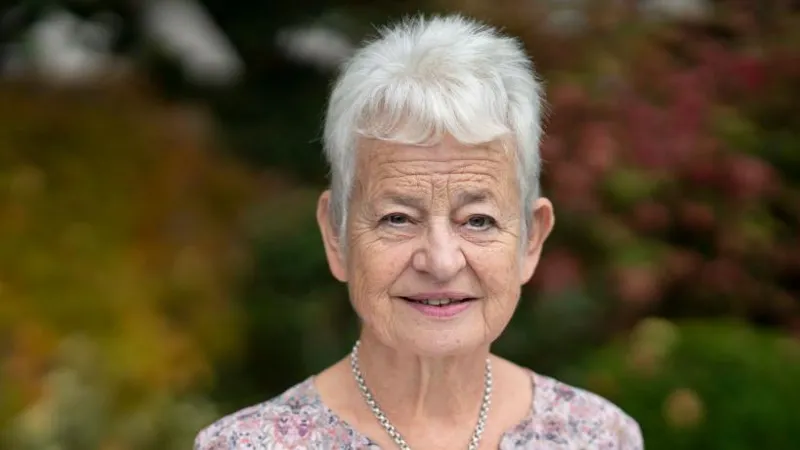
Jacqueline Wilson has been writing for more than five decades and has published hundreds of books. She describes her new novel Picture Imperfect – her adult sequel to the The Illustrated Mum – as “the easiest and the hardest thing” she’s ever written.
Published in 1999, The Illustrated Mum tells the story of two sisters – Dolphin and Star – who struggle to cope with their unstable and heavily tattooed mother Marigold, whose bipolar disorder threatens to pull their family apart.
The sequel focuses on Dolphin, 33, still looking after her mum and feeling dejected with life living in a bedsit and working at a tattoo parlour.
“It was easy because I loved that book,” Wilson tells me over a cup of coffee in a room at the Penguin Random House office, piled high with her books.
“But it was hard because people carry their own ideas of what might have happened to those characters.
“Some wanted Marigold to have recovered, or Dolphin to have a wonderful career, or Star to be the perfect big sister but real life doesn’t always work that way and I’ve always wanted my books to be true to life.”
Truth, even when uncomfortable, has always been Wilson’s trademark. From Tracy Beaker to Dustbin Baby to The Illustrated Mum, she has written about messy families, mental illness, poverty and the resilience of children navigating it all.
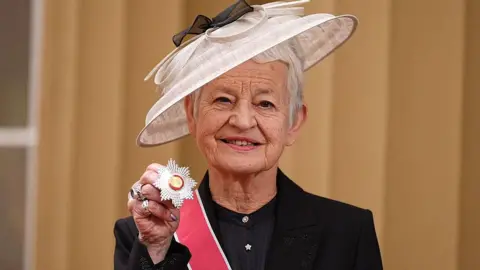
The much-loved author, who was made a dame in 2008, admits she has long felt a particular affection for The Illustrated Mum and it “is one of my favourite books”.
“It’s upsetting in some ways, but I had so many letters from children saying, ‘that’s just like my mum or my dad’,” she says.
“Recently at a concert, a woman hugged me and said ‘thank you for helping me deal with my mum’ and it almost made me cry. To think a book could matter like that all these years later, that’s why I wanted to revisit them.”
The three women’s lives have unfolded in ways both expected and painfully believable – Marigold is still not managing to take her medication or settle into stability. Star has qualified as a doctor and lives in Edinburgh, detached from Marigold’s mental health problems.
And then there is Dolphin, who Wilson sympathises with most as “she’s always the go-to person, the one holding things together when Marigold gets into bizarre scrapes”.
“She’s caring but resentful, struggling with relationships and not fulfilled,” she explains. “In this book, I wanted to give her choices in love and in work so she could figure out what she really wants.”
Too stark for children?
When The Illustrated Mum was first published, Wilson was warned that a particular scene – where Marigold covers herself in toxic white paint to hide her tattoos – might be “too stark” for children.
“I was told it was scary, maybe too much,” Wilson recalls. “But I thought, no, that moment was what would push Dolphin to finally get help. It had to be there and luckily, I got my way.”
Wilson, who lives in Sussex, insists she has no regrets about the tougher themes in her books, despite occasional criticism that she was going too far.
What makes her laugh, though, is remembering a complaint from a furious mum who accused her of ruining her daughter’s childhood because one of her books implied that 11-year-olds no longer believe in Father Christmas.
“You can’t please everyone,” Wilson chuckles.
Yet, for all her boundary-pushing, she is clear about where she draws the line.
She acknowledges young people now are exposed to far more than readers were in the 1990s or 2000s, with conversations about misogyny, online abuse and even incel culture filtering down into classrooms.
But she says those darker realities belong in her adult fiction rather than her children’s books.
“If I were to put something as troubling as the whole incel thing into a children’s book, it would only ever be implied,” she explains. “With adult books, you can more or less write what you want. With children, you have to balance being honest without overwhelming them.”
About the Author