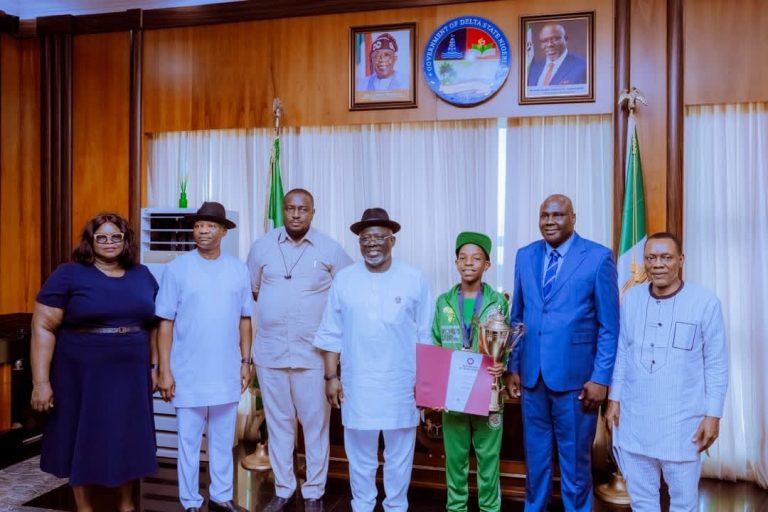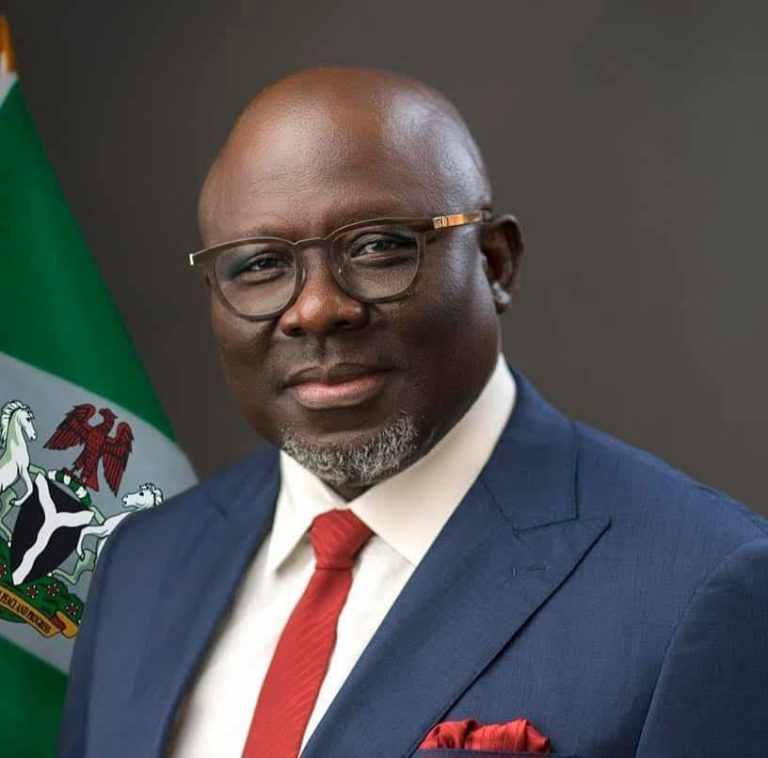
The Ndokwa Neku Union (NNU), led by President-General Chief Amaechi Asugwuni, paid a landmark courtesy visit to Delta State Governor Rt Hon Sheriff Oborevwori at Government House, Asaba. The high-powered delegation included traditional rulers, elected and appointed political leaders, and key Ndokwa stakeholders. The visit culminated in an unprecedented vote of confidence in the Governor, a formal endorsement for a second term, and the presentation of an Award for Infrastructural Development and Inclusive Leadership.
Chief Asugwuni opened the visit with a frank apology to the Governor over acts of vandalism targeting electricity installations in Ndokwaland, an act of statesmanship that set a tone of accountability.
“As a people, we condemn in the strongest possible terms every act of vandalism directed at public infrastructure. We cannot continue to demand development while allowing a few individuals to sabotage facilities meant to improve our lives,” he declared.
The NNU pledged to implement measures to safeguard power infrastructure across the region. Governor Oborevwori acknowledged that repeated vandalism had significantly delayed power restoration efforts in the area.
The delegation unanimously endorsed Governor Oborevwori for a second term, praising his commitment to fairness, accessibility, and development across Delta State. Chief Asugwuni specifically lauded the completion and handover of Ndokwa House as a landmark project that “will serve as a centre for consultation, planning and collective decision-making for generations of Ndokwa people.” The Governor’s open-door policy also received commendation, with the President-General noting that requests for engagement had consistently been met with prompt attention.
“On behalf of the NNU and the entire Ndokwa ethnic nationality, we unanimously pass a vote of confidence in Your Excellency in recognition of your exemplary, inclusive and development-oriented leadership.”
Beyond the ceremony, the delegation tabled concrete infrastructure appeals: the step-down of the Okpai Independent Power Plant to resolve chronic electricity shortages; the establishment of higher educational institutions within Ndokwa land; and the prioritisation of strategic road projects to boost connectivity and economic integration across the region. Governor Oborevwori responded warmly, reaffirming his commitment to equitable development across all parts of Delta State and praising the NNU leadership as articulate and passionate advocates for their people.
Responding to the delegation, Governor Oborevwori expressed profound gratitude to the leaders and people of Ndokwa Nation for their support and confidence in his administration. He assured them of his continued commitment to the development of all parts of Delta State, reaffirming his administration’s mantra of equity and fairness.
The Governor particularly commended his Deputy, Sir Monday Onyeme, describing him as a dedicated and effective public servant who had continued to contribute immensely to the growth and development of the state. He also praised the leadership qualities of the NNU President-General, describing Chief Asugwuni as articulate, passionate, and committed to the progress of his people.
Addressing the concerns over electricity supply, Governor Oborevwori acknowledged the challenges facing Ndokwa communities and lamented that repeated acts of vandalism had significantly delayed efforts to restore power to affected areas. He, however, assured that his administration would continue to work with relevant agencies to find lasting solutions.
The visit sparked vigorous debate within Ndokwa communities, with critics questioning the apology over vandalism offered by NNU PG, the award presentation, and the political endorsement. Some argued the NNU had overstepped its mandate as a socio-cultural body; others questioned whether collective self-accountability for individual acts was appropriate.
Ambassador Chuks Ododo, a UK-based Data and AI for Good advocate, offered a robust public defence of the NNU leadership, describing the visit as “long overdue, very strategic and intentional for the good of the Ndokwa people.” He argued that the visit had repositioned the NNU as “a key ally to government and not an enemy”, a posture that he said would unlock greater synergy and infrastructure investment for the region.
“Many tools of engagement are useful in attracting development: courtesy visits, lobbying and working as partners. NNU is a social cultural body; it is not an enemy of government.”
— Ambassador Chuks Ododo
Ambassador Ododo challenged what he described as a damaging assumption held by segments of the Ndokwa public: that development can only be won through protest, social media agitation, or perpetual opposition. “I appeal to Ndokwa people not to be comfortable in an uncomfortable wheel,” he said, arguing that effective advocacy requires a full range of instruments: dialogue, partnership, lobbying, negotiation, and accountability, not confrontation alone.
He noted that nothing in the NNU’s charter restricts the organisation to an adversarial posture with government and encouraged the President-General to remain focused and disregard criticism he described as rooted in naivety rather than critical thinking. His core message: working in genuine partnership with government, while maintaining the capacity for principled advocacy, is not weakness; it is strategy.
The Government House visit represents a defining moment in Ndokwa-State relations. By choosing partnership over posturing, the NNU leadership demonstrated political maturity and positioned Ndokwa Nation as a constructive force in Delta State’s governance conversation. The delegation’s success in combining formal endorsement with concrete development demands reflects an understanding that influence is most effective when exercised from within the circle of trust, not from outside it.
With the Governor’s warm reception and renewed public commitment to Ndokwa development on record, the onus now falls on both parties to translate goodwill into tangible progress: electricity supply, roads, and access to higher education for Ndokwa communities. The NNU’s pledge to protect public infrastructure adds a dimension of shared responsibility that strengthens its credibility as a genuine development partner and ally.
“The road to development in Ndokwa land will not be paved by protest alone. It will require advocacy, and accountability, negotiation, or dialogue and demand through strategic engagement, solidarity and scrutiny,” Ododo stated.
About the Author