By Onomiguren Agbamu
The Delta State Head of Service, Mrs. Mininim Oseji, has disclosed that the ongoing screening of civil servants by the Economic and Financial Crimes Commission (EFCC) has not uncovered any irregularities, reaffirming the state government’s commitment to transparency and accountability in the public service.
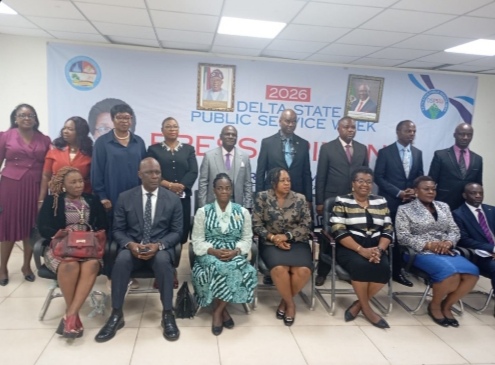
Dr. Minim Oseji, disclosed this on Monday during a press briefing in Asaba while announcing the activities for the 2026 Civil Service Week celebration,themed, “Reforms, Resilience and Results
Oseji clarified that the Delta State Government did not invite the anti-graft agency to conduct the exercise, rather, the EFCC initiated the screening as part of its nationwide efforts to investigate payroll systems and address concerns about ghost workers in public service.
She said the EFCC formally wrote to the state government requesting access to payroll records and nominal rolls from selected Ministries, Departments, and Agencies (MDAs).
She explained that “when they (EFCC) delivered the letter requesting that they wanted to screen some MDAs, I forwarded it to His Excellency, the Governor, and sought guidance on our response,”
She disclosed that “the Governor directed that we should cooperate fully because Delta State has nothing to hide, and noted that the state government subsequently approved the request and designated a senior official to coordinate the exercise and facilitate interactions between the EFCC team and the affected MDAs”.
Oseji disclosed further that her office was among those selected for screening and she personally participated in the verification exercise despite suggestions that she could be exempted.
According to her, “as the number one civil servant in the state, I wanted to lead by example, i provided my letter of first appointment, documents and my most recent appointment letter, the officials were satisfied with the documentation.”
The maintained that the Head of Service had been receiving regular updates on the screening process and that no complaints or adverse findings had been reported so far.
She reiterated the state government’s commitment to transparency, accountability and due process in public service administration, stressing that the exercise should not be viewed as punitive but rather as a measure aimed at strengthening confidence in the civil service.
Speaking on workers’ welfare, Oseji revealed that the state government had submitted proposals for an upward review of the workers’ loan scheme and was awaiting approval from the state Governor.
She explained that several reforms had been introduced to improve transparency in the loan disbursement process, including the publication of beneficiaries’ names and expected payment dates to ensure fairness and reduce complaints.
She commended the state Governor for his support for workers and pensioners, citing the recent injection of N10 billion into the state’s pension system, saying that intervention had significantly reduced the waiting period for retirees to access their benefits.
About the Author