By : Ike Philip Abiagom
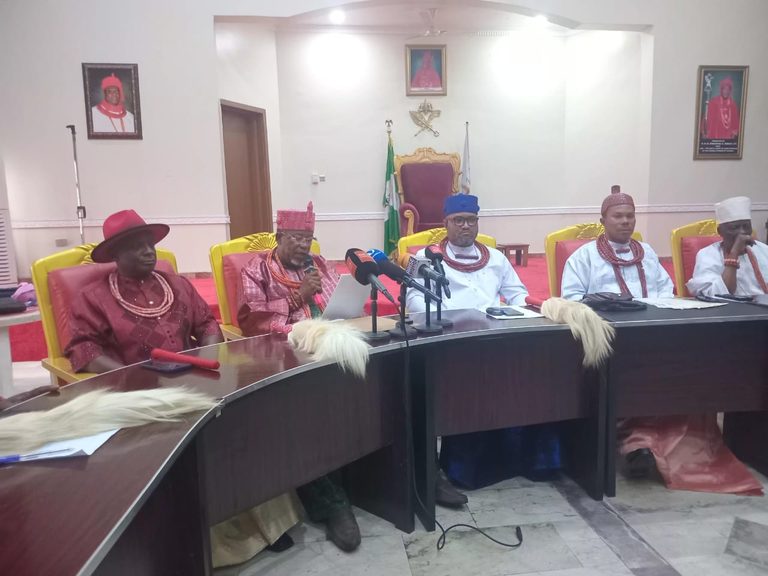
Ebu Community in Oshimili North Local Government Area of Delta State have renewed their passionate appeal to the state government for urgent intervention in the provision of road infrastructure, decrying what they describe as decades of abandonment and marginalization.
The agrarian community, which contributes to the food supply within the Delta North axis, says it cannot boast of a single functional road—either internal or external—despite existing for decades as a recognized settlement within the state.
Community leaders and residents lament that for over 30 years, Ebu has remained cut off from meaningful development, with poor infrastructure continuing to stifle economic growth and social wellbeing.
Particularly heartbreaking to the people is the collapse of the once strategic Ebu–Ukala–Ezi road, constructed about 27 years ago during the administration of former Delta State Governor, James Ibori. The road, which served as a vital economic corridor linking Ebu to neighboring communities such as Ukala and Ezi, and further connecting to other parts of Delta North, has now deteriorated beyond use. Residents say vehicles can no longer ply the route, effectively isolating the community.
Currently, the only accessible route to Ebu is through Illah road, a federal road that is itself in a deplorable condition, compounding the hardship faced by residents, farmers, traders, and students.
Within the community, the situation is no better. There are no motorable internal roads, including the critical palace road that leads to key institutions such as Ebu Health Centre and Ebu Grammar School. The road has become so dilapidated that vehicles are unable to access these essential facilities, leaving residents to trek long distances under harsh conditions.
We are asking: what offence has Ebu committed to deserve this level of neglect? a community leader queried. How can a community in Delta State, sharing boundaries with Edo State, be left in such a state of infrastructural decay for decades?
The frustration of the people reached a peak last year when Ebu, alongside neighboring communities of Ezi and Ukala, staged a peaceful protest at the Government House in Asaba. The protest was aimed at drawing the attention of the state government, led by Sheriff Oborevwori, to the dire condition of the Ebu–Ukala–Ezi road and the broader infrastructural challenges facing the area.
Although assurances were reportedly given by the Chief of Staff to the Governor that the matter would receive prompt attention, residents say no visible action has been taken to date.
Community members emphasize that roads are the lifeline of any society, noting that Ebu’s predominantly farming population is severely affected by the inability to transport agricultural produce to markets in neighboring towns. This, they say, not only undermines livelihoods but also affects food supply chains in the region.
Despite the challenges, the people of Ebu maintain that they are peaceful and law-abiding. They have therefore chosen the path of dialogue and appeal, calling on Governor Oborevwori to extend his administration’s developmental strides to their community.
Our working Governor Oborevwori has demonstrated capacity across the three senatorial districts through various infrastructural projects.
We are appealing to him to remember Ebu Community, especially by rehabilitating the Ebu–Ukala–Ezi road, which remains our only economic lifeline, the community stated.
The people further stressed their political support for the current administration, noting that they voted overwhelmingly for the governor in the last election and remain committed to supporting his leadership in the future.
As the cries for help grow louder, stakeholders say urgent intervention is needed to prevent Ebu from slipping further into isolation and being completely erased from Delta State’s infrastructural map.
About the Author