
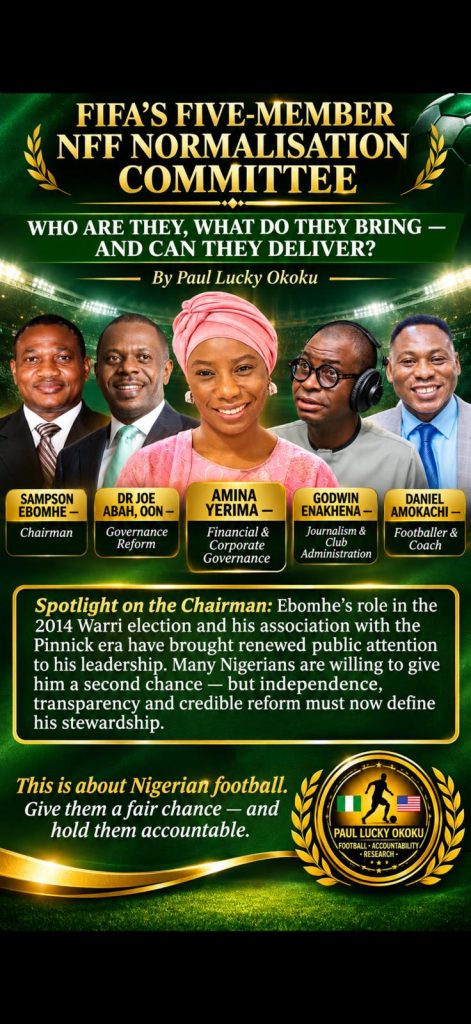
FIFA NORMALISATION COMMITTEE: Okoku Examines Five Members, Questions Electoral Structure, Urges Lasting NFF Reforms
By Paul Lucky Okoku
Renowned football commentator and analyst, Paul Lucky Okoku, has examined the composition, professional backgrounds and reform responsibilities of the five-member FIFA-appointed Nigeria Football Federation (NFF) Normalisation Committee, calling for greater transparency, accountability and a more representative electoral structure in Nigerian football.
In an extensive analysis, Okoku identified the five members as Sampson Ebomhe, Chairman; Dr Joe Abah; Godwin Enakhena; Amina Yerima; and former Super Eagles international, Daniel Amokachi.
He noted that the committee was established by FIFA following consultations with the Confederation of African Football (CAF), with the responsibility of managing the affairs of the NFF, reviewing its statutes and electoral framework, and preparing the ground for a credible election.
According to him, the committee’s assignment presents an important opportunity to address longstanding governance challenges that have continued to affect Nigerian football administration.
EBOMHE’S APPOINTMENT AND THE 2014 NFF ELECTION
Okoku expressed particular interest in the appointment of Ebomhe as chairman, given his previous involvement in the controversial September 30, 2014 NFF presidential election in Warri, Delta State.
Ebomhe, a lawyer who graduated from the University of Benin in 1987 and was called to the Nigerian Bar in 1988, previously chaired the NFF Electoral Committee that supervised the election which produced Amaju Pinnick as federation president.
The election generated considerable controversy over electoral procedures, eligibility requirements and the exclusion of presidential aspirant Shehu Dikko.
Okoku recalled that Ebomhe was reportedly detained by security operatives before the election, resulting in a delay in proceedings. The controversy continued after the Federal High Court in Jos set aside the Warri proceedings in litigation involving earlier court orders.
He said Ebomhe’s previous involvement in the electoral process would inevitably attract public scrutiny, particularly regarding his ability to guarantee independence, fairness and transparency in the forthcoming reforms.
Nevertheless, Okoku expressed confidence that the chairman deserved an opportunity to demonstrate his capacity to deliver meaningful institutional reforms.
“The past is part of the record. His present decisions and the reforms he helps deliver will determine his legacy,” he stated.
He also stressed that football autonomy should not be confused with immunity from financial accountability, insisting that FIFA’s regulations against third-party interference must not be used to shield football administrators from legitimate audits and public scrutiny.
ABAH BRINGS GOVERNANCE AND INSTITUTIONAL REFORM EXPERIENCE
On Dr Joe Abah, Okoku described him as an important addition to the committee because of his extensive experience in governance and public-sector reforms.
Abah is a lawyer qualified in Nigeria and England and Wales, with a doctorate in Governance and Public Policy Analysis from Maastricht University.
He previously served as Director-General of the Bureau of Public Service Reforms between 2013 and 2017 and has worked in international development and institutional reform.
Okoku believes his expertise could help strengthen NFF statutes, establish clearer administrative responsibilities, protect stakeholder rights and introduce governance safeguards capable of surviving changes in leadership.
He emphasised that successful reforms must be practical and sustainable rather than merely attractive on paper.
ENAKHENA’S JOURNALISM AND FOOTBALL ADMINISTRATION EXPERIENCE
The appointment of Godwin Enakhena, according to Okoku, brings an important combination of sports journalism, broadcasting and football administration experience to the committee.
Enakhena is associated with Global Media and the Sports Writers Association of Nigeria (SWAN). He is also recognised for presenting Sports Splash on Lagos Television (LTV 8) and Top Sports on Top Radio 90.9 FM.
His broadcasting career has earned him recognition as Sports Presenter of the Year at the Nigerian Broadcasters Merit Awards.
Beyond journalism, Enakhena has occupied several football administrative positions, including chairman of MFM FC and Sporting Lagos FC, Director of Sports at Mountain of Fire and Miracles Ministries, and General Secretary of the professional league’s Club Owners Association.
Okoku particularly highlighted his involvement in the development of MFM FC, which secured promotion to the Nigeria Professional Football League in 2015, finished second in the 2017 season and subsequently represented Nigeria in the 2018 CAF Champions League.
He said Enakhena’s experience from both the media and administrative sides of football could contribute to improved league governance, club licensing, contractual compliance and communication between the NFF and football stakeholders.
He added that transparency should remain a guiding principle even when journalists become football administrators.
YERIMA’S FINANCIAL AND AUDIT EXPERTISE
Okoku described Amina Yerima as a valuable addition to the committee because of her reported experience in taxation, auditing, financial management and corporate governance.
Yerima reportedly holds an Accounting degree from the University of Abuja and is a Fellow of the Association of Chartered Certified Accountants (FCCA).
Her professional experience includes assignments associated with the World Bank-supported States’ Fiscal Transparency, Accountability and Sustainability (SFTAS) programme.
According to Okoku, her financial expertise could help establish stronger budgeting procedures, procurement controls, independent oversight and transparent reporting of football-development funds.
He argued that the NFF needs verifiable financial records and stronger mechanisms for monitoring FIFA Forward funds and ensuring that football-development projects are properly implemented.
Although the committee’s published mandate does not expressly provide for a comprehensive forensic audit of previous NFF administrations, he believes Yerima could help strengthen financial safeguards and recommend appropriate independent reviews.
AMOKACHI REPRESENTS THE PLAYERS’ AND TECHNICAL PERSPECTIVE
The fifth member, Daniel Amokachi, popularly known as The Bull, brings considerable football experience as a former international, coach and sports administrator.
Amokachi represented Nigeria at the 1994 and 1998 FIFA World Cups, won the 1994 Africa Cup of Nations and was part of the historic Nigerian team that won Olympic football gold at Atlanta 1996.
His professional career included spells with Club Brugge, Everton and Besiktas. He also won the 1995 FA Cup with Everton.
After retiring from active football, he moved into coaching and served on the Super Eagles technical staff during Nigeria’s 2013 Africa Cup of Nations triumph under the late Stephen Keshi.
He also served as Nigeria’s Football Ambassador and Special Assistant on Sports to former President Muhammadu Buhari.
Okoku said Amokachi’s experience could help bring the perspectives of players and coaches into the committee’s deliberations, particularly on player welfare, contractual obligations, insurance, career development and stakeholder representation.
He, however, noted that the former international’s contribution would ultimately be measured by the extent to which his experience translates into lasting institutional improvements.
ONE COMMITTEE, ONE COLLECTIVE MANDATE
Okoku emphasised that FIFA had not assigned exclusive portfolios to individual members, stressing that the five officials must work collectively to fulfil their responsibilities.
Their responsibilities include managing the NFF’s daily affairs during the transition, reviewing the federation’s statutes, revising the Electoral Code in consultation with FIFA and CAF, and preparing proposals for reforms involving the NFF, State Football Associations, leagues and other stakeholders.
The committee is also expected to organise elections under the revised statutory framework, with its mandate ending no later than May 31, 2027.
He warned that the real test would be whether the committee merely organises another election or establishes a more representative and credible system for Nigerian football.
GHANA, CÔTE D’IVOIRE AND BOSNIA: LESSONS FOR NIGERIA
In examining possible electoral reforms, Okoku drew attention to the experiences of Ghana, Côte d’Ivoire and Bosnia and Herzegovina, countries that previously underwent FIFA-supervised normalisation processes.
He explained that Ghana’s 2025 statutes provide for 124 Congress votes, with clubs collectively controlling 92 votes, representing approximately 74.19 per cent.
In Côte d’Ivoire, reported 2026 voting arrangements identify 89 voting members exercising 149 weighted votes, with clubs controlling 144 votes, representing approximately 96.64 per cent.
Bosnia and Herzegovina provides another example of structural reform. Under its 2023 statutes, the General Assembly comprises 60 delegates, with 40 representing the Football Federation of the Federation of Bosnia and Herzegovina and 20 representing the Football Association of Republika Srpska.
Okoku observed that these examples demonstrate different approaches to distributing electoral power, but warned that greater club representation does not automatically guarantee adequate participation by players, coaches, referees and other football stakeholders.
He argued that Nigeria should carefully study these arrangements before adopting a model suited to its own football environment.
NIGERIA’S 68.52 PER CENT ELECTORAL QUESTION
A major concern raised by Okoku is the distribution of voting power within the NFF Congress.
According to the March 2026 arrangement cited in his analysis, the NFF Congress has 54 votes, with the 36 State Football Associations and the Federal Capital Territory collectively controlling 37 votes.
This represents approximately 68.52 per cent of the total voting strength, while all other stakeholder categories combined account for 17 votes, representing 31.48 per cent.
He noted that this distribution gives the State Football Associations and FCT a decisive advantage in determining the outcome of elections if their representatives vote together.
While acknowledging the legitimate responsibilities of State Football Associations, Okoku questioned whether the present distribution adequately reflects the contributions and interests of clubs, players, coaches, referees and other stakeholders.
He maintained that electoral reform should not simply redistribute power among existing administrators but should create a genuinely inclusive structure that gives the wider football community a meaningful voice.
THE REAL TEST IS DELIVERY
Okoku concluded that FIFA’s intervention offers Nigerian football an opportunity to address institutional weaknesses that have persisted through successive administrations.
He urged the five members to demonstrate independence, avoid conflicts of interest, promote transparency and ensure that the revised electoral framework enjoys the confidence of football stakeholders.
He also called for meaningful consultations with clubs, players, coaches, referees, football administrators and other relevant groups before the adoption of any new governance structure.
According to him, the success of the Normalisation Committee should not be measured solely by its ability to conduct an election before the expiration of its mandate.
Rather, its legacy should be determined by whether it establishes a credible, transparent and inclusive football administration capable of protecting the interests of Nigerian football beyond the tenure of its members.
“Nigeria does not merely need another NFF election. It needs an electoral and governance system that will make future elections credible, protect stakeholder interests and restore public confidence in football administration.”
He stressed that the ultimate responsibility before the committee was to deliver lasting reforms that would place Nigerian football on a stronger institutional foundation.