
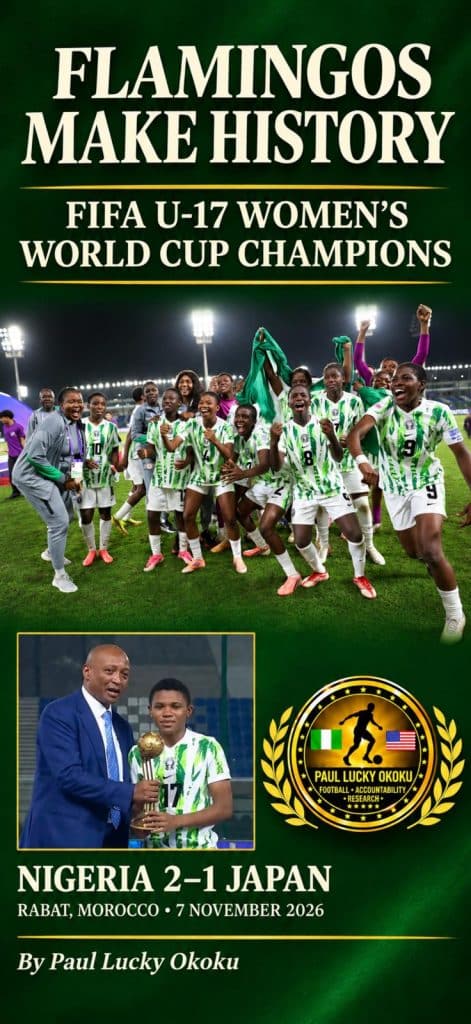
FLAMINGOS MAKE HISTORY, DEFEAT JAPAN 2–1 TO WIN 2026 FIFA U-17 WOMEN’S WORLD CUP
By Paul Lucky Okoku
Nigeria’s Flamingos have made history by winning their first-ever FIFA U-17 Women’s World Cup title after defeating Japan 2–1 in a thrilling final played on Saturday, November 7, 2026, at the Mohammed VI Football Complex, Pitch 3, in Rabat, Morocco.
The victory also made Nigeria the first African country to win both the boys’ and girls’ FIFA U-17 World Cups, adding the Flamingos’ historic triumph to the five titles previously won by the country’s Golden Eaglets.
Nigeria’s goals came through Awawu Bashiru in the 39th minute and Oluebube Umejiaku two minutes after the restart, while Fuki Ito scored Japan’s consolation goal in the 80th minute.
Despite Japan enjoying a greater share of possession, recording 52.9 per cent against Nigeria’s 47.1 per cent, the Flamingos demonstrated remarkable discipline, tactical awareness and determination to secure the historic victory.
Both teams recorded 12 shots each, but Nigeria managed three shots on target compared with Japan’s two.
Umejiaku, whose outstanding performance included a beautifully executed second goal, was named FIFA Player of the Match.
FROM POLAND’S DEFEAT TO WORLD CHAMPIONS
The Flamingos’ journey to the championship was marked by resilience and a remarkable recovery following their disappointing 2–1 defeat to Poland on October 17.
The defeat exposed some weaknesses in the Nigerian team’s defensive organisation, concentration and finishing, prompting criticism of the players and technical crew.
Head coach Akeem Busari subsequently identified fatigue and lapses in concentration as some of the factors responsible for the setback.
However, the Nigerian girls responded positively, defeating Puerto Rico 2–0 on October 20 before recording an impressive 3–1 victory over defending champions DPR Korea on October 23.
They continued their impressive run with a 2–1 victory over Mexico on October 29, before edging Venezuela 1–0 on November 1, courtesy of Azeezaat Oduntan’s 89th-minute penalty.
In the semifinal played on November 4, Nigeria defeated Brazil 3–1, with Awawu Bashiru scoring twice after being introduced into the starting lineup by Busari.
Her outstanding performance earned her a place in the starting eleven for the final against Japan, where she again proved decisive by scoring Nigeria’s opening goal.
BASHIRU AND UMEJIAKU INSPIRE HISTORIC VICTORY
The final was an entertaining encounter that tested the resilience and tactical discipline of both teams.
Nigeria came close to opening the scoring when Oluebube Umejiaku went around Japanese goalkeeper Kou Kadowaki but failed to convert the opportunity.
In the 37th minute, another Nigerian attacking opportunity saw Kadowaki spill a wide free kick, allowing Umejiaku to head the ball against the crossbar.
However, two minutes later, Awawu Bashiru produced an effort from outside the penalty area which slipped through the goalkeeper’s gloves to give Nigeria a 1–0 lead before halftime.
The Flamingos doubled their advantage just two minutes into the second half through a brilliant attacking combination involving defender Esther Stephen and Umejiaku.
Stephen spotted Umejiaku’s intelligent run behind the Japanese defence and delivered an early pass. The Nigerian forward controlled the ball with her left foot before calmly lifting it over the advancing goalkeeper to make it 2–0.
The goal demonstrated Nigeria’s attacking awareness and ability to exploit spaces behind the opposition’s defensive line.
Japan, however, refused to surrender and continued pressing for a way back into the contest.
Their determination paid off in the 80th minute when substitute defender Anri Ito headed a corner kick back across the Nigerian goal area, allowing Fuki Ito to volley the ball into the net.
The goal reduced the deficit to 2–1 and set up a tense closing period.
With four minutes of added time, the Flamingos defended resolutely, resisting Japan’s attempts to find an equaliser until the final whistle confirmed Nigeria’s historic triumph.
TACTICAL LESSONS FROM THE FINAL
The victory highlighted the importance of anticipation, decision-making and tactical discipline in modern football.
One of the outstanding moments was Esther Stephen’s early pass to Umejiaku for Nigeria’s second goal. Stephen recognised the forward’s movement and released the ball before the Japanese defenders could recover their positions.
At the other end, Japan demonstrated similar awareness when Anri Ito redirected the ball across goal for Fuki Ito to score.
The contrasting situations offered important lessons about defensive concentration, marking opponents and anticipating the next movement of the ball.
Although Japan enjoyed more possession, Nigeria demonstrated that effective use of available spaces, timely passing and disciplined defending could overcome an opponent with greater ball control.
BUSARI’S TACTICAL DECISIONS PAY OFF
Head coach Akeem Busari deserves considerable credit for the team’s transformation following the opening defeat to Poland.
His decision to introduce Awawu Bashiru from the bench before eventually promoting her to the starting lineup proved particularly rewarding.
Bashiru’s two-goal performance against Brazil in the semifinal earned her a starting role in the final, where she scored the opening goal against Japan.
The achievement also reflected the collective efforts of the assistant coaches, goalkeeping coach, medical personnel, training staff and other members of the technical team who worked behind the scenes to prepare the players for the demanding tournament.
Above all, the Flamingos demonstrated remarkable belief in themselves, their coaches and the collective objective of bringing the trophy home.
A NEW CHAPTER IN NIGERIAN FOOTBALL HISTORY
Nigeria’s triumph in Morocco represents a significant milestone for women’s football in the country and across Africa.
While the Golden Eaglets have established Nigeria as a dominant force in the boys’ U-17 competition with five world titles, the Flamingos have now written a historic chapter of their own by conquering the girls’ competition for the first time.
Their achievement sends a powerful message to young girls across Nigeria and the African continent that they, too, can compete at the highest level and become world champions.
From the disappointment of Poland to the celebrations in Morocco, the Flamingos demonstrated that setbacks do not have to determine the outcome of a campaign.
As the Stoic philosopher Epictetus observed in his Enchiridion, some things are within our control while others are not. Nigeria’s young champions could not change their opening defeat, but they could determine how they responded to it.
Six victories later, they stood on top of the world.
The Flamingos have not only won a trophy; they have inspired a generation and raised Nigeria’s flag high on the global football stage.
Congratulations to Nigeria’s Flamingos, the 2026 FIFA U-17 Women’s World Cup champions!
Paul Lucky Okoku
FIFA Legend | Former Nigeria Flying Eagles Vice-Captain | Former Super Eagles International | AFCON Silver Medalist | Football Historian | Football Analyst | Investigative Football Writer | Journalist-at-Large | Founder & CEO, Greater Tomorrow Children’s Fund (GTCF)