Former Nigerian international recounts his journey from Lagos streets to the 1983 FIFA World Youth Championship and the historic Morocco assignment
By Paul Lucky Okoku
The remarkable journey of former Nigerian international footballer, Paul Lucky Okoku, from playing football with rubber balls on the streets of Lagos to representing Nigeria at the highest levels of international football is a story of talent, discipline, sacrifice and determination.
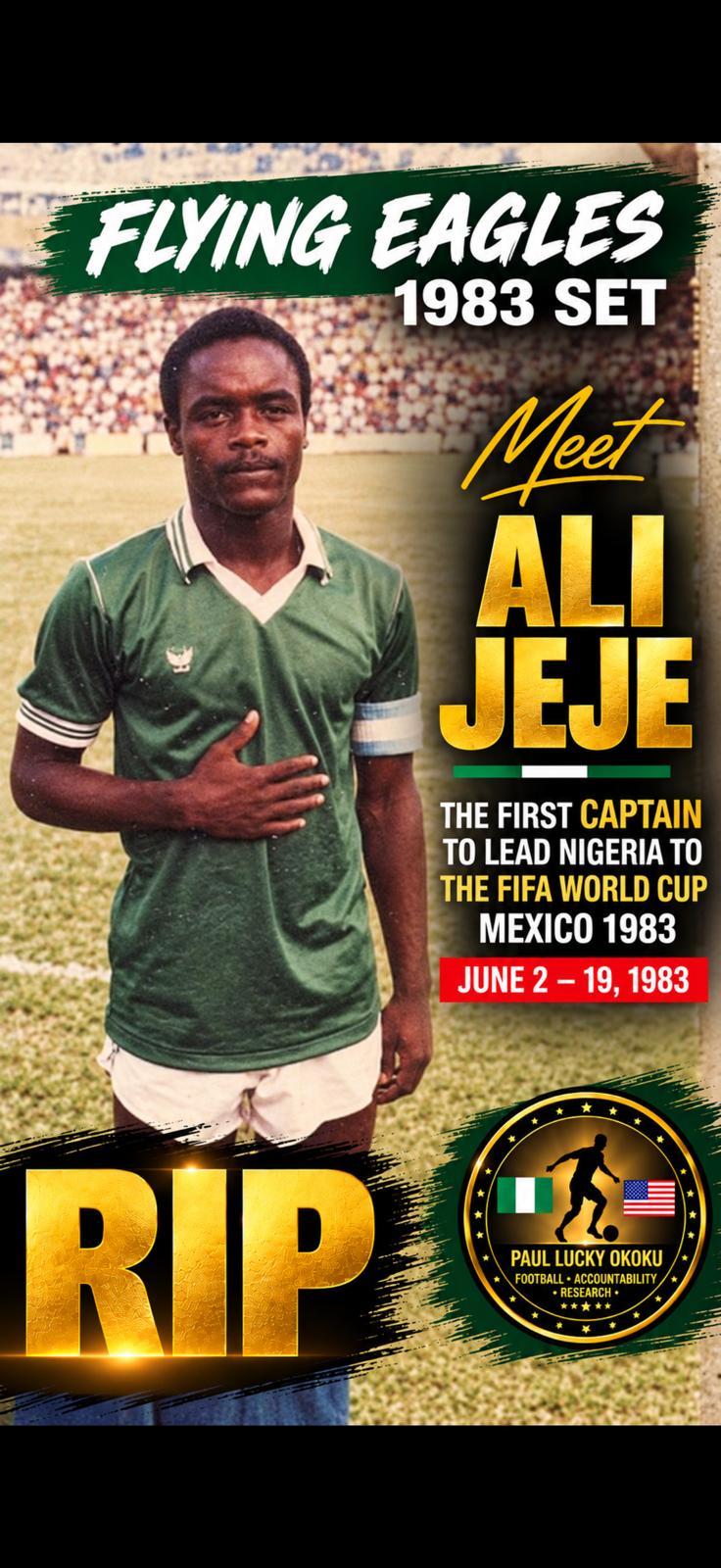
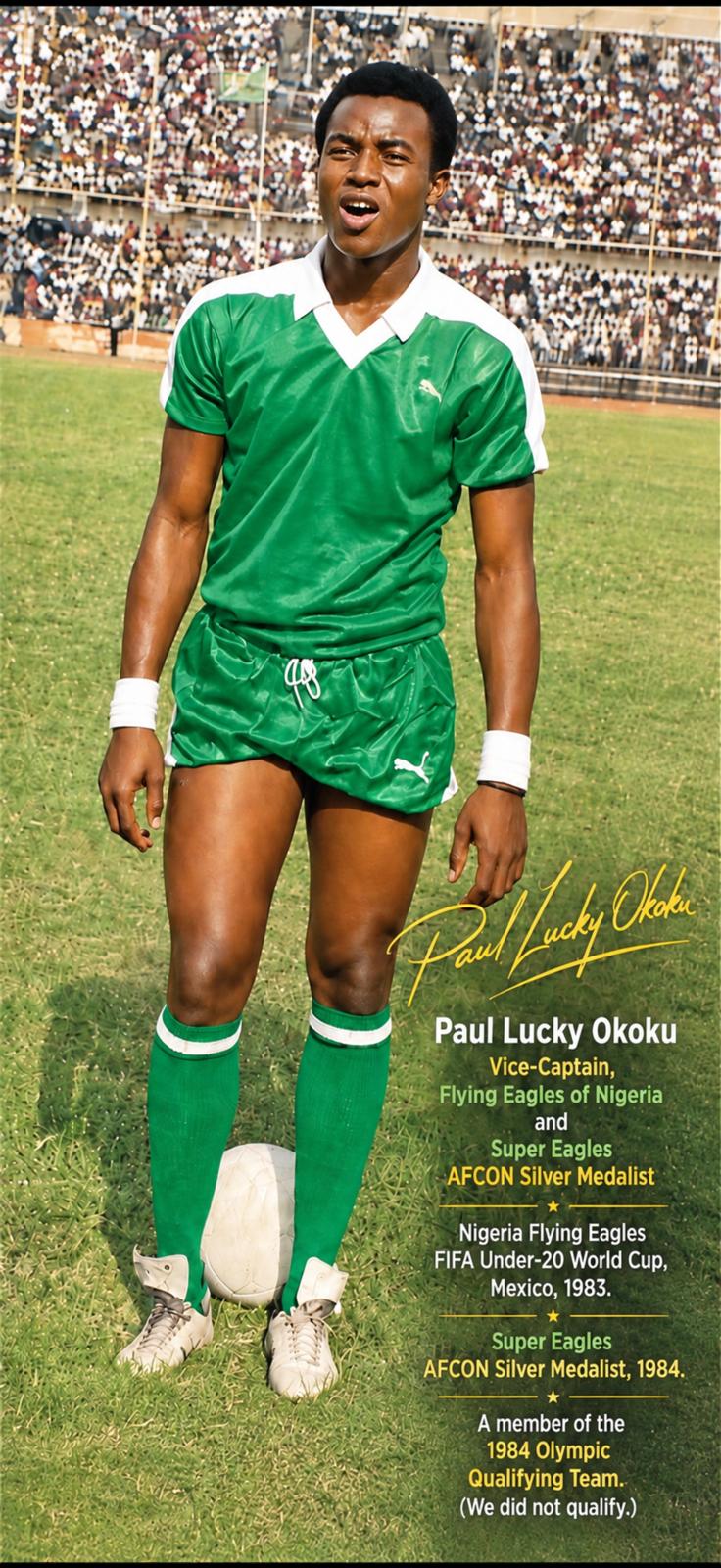
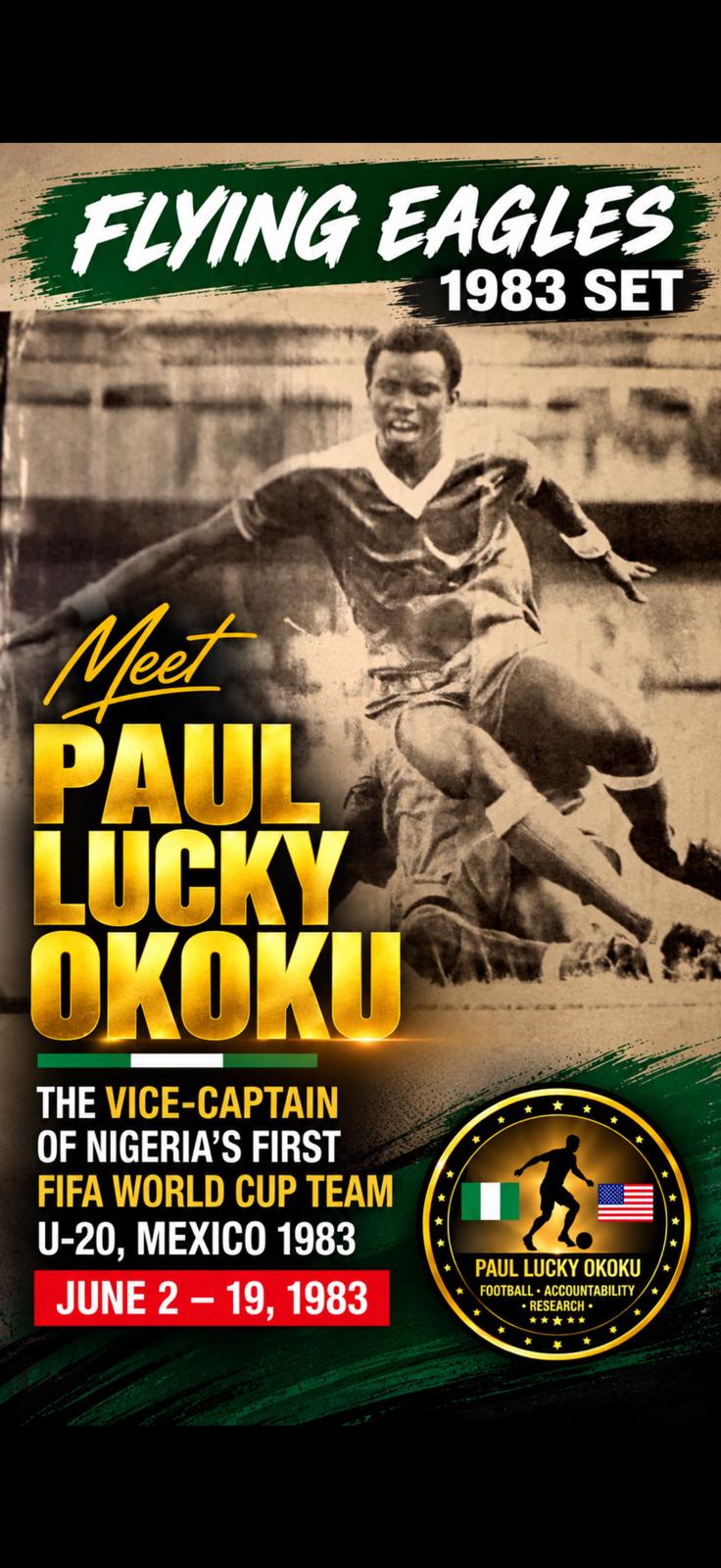
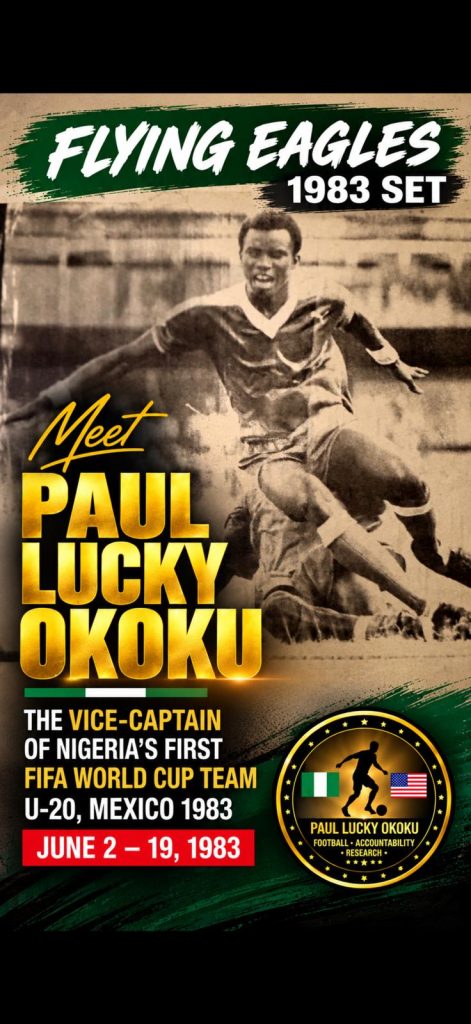
Okoku, who served as vice-captain of Nigeria’s pioneering 1983 Flying Eagles alongside the late captain Ali Jeje, has recounted his experiences as part of a generation that made history by becoming the first Nigerian national football team to participate in a FIFA World Cup competition.
In the second instalment of his historical series, Meet the 1983 Flying Eagles, Okoku offers a fascinating account of his football beginnings, education, international achievements and an extraordinary assignment that saw him and two teammates represent Nigeria’s youth and senior national teams within the same period.
FROM LAGOS STREETS TO INTERNATIONAL FOOTBALL
Okoku’s football journey began in the neighbourhood streets of Lagos, where he developed his skills playing with the rubber ball popularly known as felele.
He attended St. Paul’s Primary School, Apapa Road, Lagos, before proceeding to Zumraltu Islamiyah Grammar School, Yaba, and later St. Finbarr’s College, Akoka, Lagos, an institution renowned for its rich football tradition.
Through school competitions and the Youth Sports Federation of Nigeria (YSFON), he gradually developed into a disciplined and competitive footballer.
His generation recorded notable successes, including victories at the 1981 Gothia Cup in Sweden and the Dallas Cup in the United States.
At club level, Okoku featured for National Bank FC, Abiola Babes and Leventis United, where he established himself as a defensive midfielder known for his tactical awareness, positional discipline and ability to initiate attacking moves.
MAKING HISTORY WITH THE 1983 FLYING EAGLES
A defining moment in Okoku’s career came on January 8, 1983, when Nigeria defeated Guinea 2–0 in Lagos to secure qualification for the FIFA World Youth Championship in Mexico.
The team, coached by Christopher Udemezue and assisted by Isiaka Yakubu, embarked on an intensive preparation programme ahead of the historic tournament.
Held from June 2 to 19, 1983, in Mexico, the competition marked Nigeria’s first appearance at a FIFA World Cup tournament at any level.
Wearing jersey number four, Okoku played as a defensive midfielder and served as vice-captain to the late Ali Jeje.
The tournament established a historic foundation for subsequent generations of Nigerian footballers.
THE THREE UCHES: OKOKU, EHILEGBU AND SHOFOLUWE
One of the most interesting aspects of the 1983 Flying Eagles’ dressing-room culture was the nickname given to three players: Paul Lucky Okoku, Chibuzor Ehilegbu and Yisa Shofoluwe.
They were popularly known as the “Three Uches”, a nickname inspired by the Igbo word Uche, associated with thought and intelligence.
Their Yoruba-speaking teammates described the quality as Ologbon, while Hausa speakers used Hankali. In English, they were simply the “Sense Men”.
According to Okoku, the nickname reflected their ability to use intelligence, anticipation and deception to outwit opponents.
Their coach, Christopher Udemezue, also adopted the nickname and frequently reminded them of the high standards expected of them.
Whenever the trio failed to perform to their usual standard, Udemezue would fold his arms, stretch his neck forward and declare in Nigerian Pidgin: “Uche, this one no be am!”
The expression became one of the memorable dressing-room moments of their time together.
The three players distinguished themselves through their ability to disguise passes, execute clever movements and read the game ahead of their opponents.
While Okoku operated from defensive midfield, Ehilegbu demonstrated composure and tactical intelligence, while Shofoluwe combined defensive responsibilities with attacking instincts developed from his early days as an outside-right player.
Their football intelligence would soon attract attention beyond the youth national team.
FROM THE FLYING EAGLES TO THE GREEN EAGLES: THE 1983 MOROCCO ASSIGNMENT
Perhaps one of the most remarkable chapters of Okoku’s international career was his unexpected call-up to Nigeria’s senior national team for the decisive 1983 Africa Cup of Nations qualifying encounter against Morocco.
On August 14, 1983, Nigeria’s Green Eagles had played a goalless draw against Morocco in Benin City.
With several senior players failing to return to camp after the first leg, coach Adegboye Onigbinde faced a selection challenge ahead of the crucial return fixture in Rabat.
He subsequently turned to the Flying Eagles, who had recently returned from the World Youth Championship in Mexico and were preparing for the West African Football Union (WAFU) Cup at Bembo Games Village in Ibadan.
Three players were selected: Paul Lucky Okoku, Chibuzor Ehilegbu and Yisa Shofoluwe.
At the time, the Flying Eagles were under the guidance of coach Paul Hamilton, assisted by Tunde Disu, following the reassignment of Udemezue and his assistant, Isiaka Yakubu.
With just four days remaining before the Morocco encounter, the three youngsters joined the senior national-team delegation.
According to Okoku’s recollection, they travelled with the Green Eagles delegation from Bembo Games Village to Lagos, spent the night there and departed the following morning aboard Iberia Airlines for Madrid, Spain.
After an overnight stay in Madrid, they continued their journey to Rabat, Morocco.
The three youngsters were therefore not travelling independently to meet the senior team. They were officially part of the Green Eagles delegation throughout the journey from Ibadan.
ERNEST OKONKWO AND THE DINING-ROOM ENCOUNTER
Another memorable moment occurred at the team’s hotel in Morocco.
Legendary Radio Nigeria football commentator Ernest Okonkwo was reportedly moving around the dining room, familiarising himself with the players ahead of his match commentary.
When he encountered Okoku, Ehilegbu and Shofoluwe sitting together, he recognised their common football background and referred to them as “The Udemezue Boys”.
The description was a tribute to Christopher Udemezue, whose work with the Flying Eagles had helped prepare the youngsters for international football.
RABAT: THE GOLDEN BOYS DELIVER
On Sunday, August 28, 1983, Nigeria faced Morocco in the decisive return leg in Rabat.
The match ended goalless after regulation time and extra time, forcing the encounter into a penalty shootout.
The Green Eagles eventually triumphed 4–3 on penalties, securing qualification for the 1984 Africa Cup of Nations in Côte d’Ivoire.
Goalkeeper Peter Rufai emerged as one of the heroes of the dramatic encounter.
Following Nigeria’s qualification, coach Adegboye Onigbinde reportedly embraced Okoku, Ehilegbu and Shofoluwe together and affectionately described them as “My Golden Boys”.
For the three youngsters, who had only recently represented Nigeria at the World Youth Championship in Mexico, it was a memorable recognition of the confidence reposed in them by the senior national-team coach.
The nickname “Three Uches” had originated among their youth-team colleagues, while “The Udemezue Boys” was Ernest Okonkwo’s description. In Rabat, however, Onigbinde gave them another identity: his Golden Boys.
A RARE DISTINCTION IN NIGERIAN FOOTBALL
The Morocco assignment placed Okoku, Ehilegbu and Shofoluwe among a rare group of Nigerian footballers who represented the Flying Eagles and the senior Green Eagles simultaneously during the same period of their international careers.
Their experience was particularly significant because they returned to their youth-team responsibilities after the senior assignment.
Following the Morocco encounter, the trio rejoined the Flying Eagles and participated in Nigeria’s victorious 1983 WAFU tournament.
Their experience demonstrated the possibilities of developing young footballers while also giving them opportunities to contribute to the senior national team.
Henry Nwosu had earlier established a comparable precedent, having featured for Nigeria’s victorious 1980 Africa Cup of Nations team before returning to youth international football, including the Flying Eagles’ 1981 World Cup qualifying campaign against Cameroon.
For Okoku and his two colleagues, the experience represented an extraordinary chapter in their football careers.
AFCON 1984: ANOTHER HISTORIC MILESTONE
Okoku’s international career continued to flourish following the Morocco assignment.
In 1984, he represented Nigeria at the Africa Cup of Nations in Côte d’Ivoire, where the Green Eagles reached the final and finished as runners-up, earning the silver medal.
His progression from neighbourhood football in Lagos to the Flying Eagles and subsequently the senior national team reflected the opportunities created by talent, discipline and perseverance.
CHOOSING EDUCATION AFTER FOOTBALL
Despite his accomplishments on the football field, Okoku made a deliberate decision to pursue higher education in the United States.
He attended Alabama A&M University, where he combined his academic studies with football and eventually graduated Magna Cum Laude with a degree in Finance.
His decision was influenced by his conviction that education and sporting excellence should complement each other.
He also reflected on the economic principle of opportunity cost, recognising that every major decision involves sacrificing alternative opportunities.
For Okoku, pursuing university education was a conscious investment in his future, even when it meant foregoing some of the immediate possibilities associated with a professional football career.
As he puts it, football opened the door, but education helped him walk through it.
His professional career subsequently extended into finance, business operations and corporate management.
GIVING BACK THROUGH HUMANITARIAN SERVICE
In 2014, Okoku established the Greater Tomorrow Children’s Fund (GTCF), an initiative dedicated to supporting underserved children and communities through educational resources and humanitarian assistance.
Beyond his professional and humanitarian engagements, he remains committed to documenting Nigerian football history, recognising overlooked contributors and examining issues of football leadership and accountability.
His continued association with former teammates and institutions such as St. Finbarr’s College also reflects the enduring relationships established during his formative years.
FOOTBALL AS A VEHICLE FOR LIFE
For Okoku, the story goes beyond medals, international appearances and football records.
It is also about the teachers who encouraged him, the coaches who demanded excellence, the teammates who shared responsibility and the opportunities that football created beyond the pitch.
His guiding philosophy captures this belief:
“Football was not an end in itself. It was transportation through life’s journey.”
He hopes that younger generations of Nigerian footballers will appreciate that sporting success should not be the only objective of their careers. Education, personal development and service to society are equally important.
A LEGACY WORTH PRESERVING
Paul Lucky Okoku’s story represents an important chapter in the history of Nigerian football.
From the streets of Lagos to the historic 1983 FIFA World Youth Championship in Mexico, from the Three Uches to Onigbinde’s Golden Boys in Rabat, and eventually to the 1984 Africa Cup of Nations final, his career reflects a remarkable journey through different generations and levels of Nigerian football.
His decision to pursue higher education and humanitarian service after his playing career further demonstrates the value of preparing for life beyond football.
Today, Okoku is recognised as a former Flying Eagles vice-captain, former Super Eagles international, AFCON silver medallist, football historian, analyst, investigative football writer and founder and CEO of the Greater Tomorrow Children’s Fund.
His story deserves preservation, not merely as an account of individual achievement, but as part of the collective history of the pioneers who helped shape Nigerian football.
PROFILE AT A GLANCE
Paul Lucky Okoku
- FIFA Legend
- Former Nigeria Flying Eagles Vice-Captain
- Former Super Eagles International
- 1984 AFCON Silver Medallist
- Former National Bank FC, Abiola Babes and Leventis United player
- Finance graduate, Alabama A&M University (Magna Cum Laude)
- Football Historian and Analyst
- Investigative Football Writer
- Journalist-at-Large
- Founder and CEO, Greater Tomorrow Children’s Fund (GTCF)
ABOUT THIS SERIES
This is Part 2 of a historical series documenting the pioneering members of Nigeria’s 1983 Flying Eagles, the first Nigerian national football team to participate in a FIFA World Cup tournament.
Although Paul Lucky Okoku is both the author and subject of this profile, the story is presented in the third person to maintain consistency throughout the series.
The account combines historical tournament and match records with Okoku’s firsthand recollections, particularly concerning the Morocco assignment, the team’s journey, the encounter with Ernest Okonkwo and the post-match embrace by coach Adegboye Onigbinde.
Readers are encouraged to share this story to help preserve the history of Nigeria’s football pioneers and inspire future generations.
For comments and useful materials always visit ndokwavanguard.org
08034012306 (WhatsApp only)
About the Author