Ebomhe’s Appointment As NFF Normalization Committee Chair Raises Questions Over 2014 Warri Election
Paul Lucky Okoku urges transparency, electoral reforms and broader stakeholder representation in Nigerian football
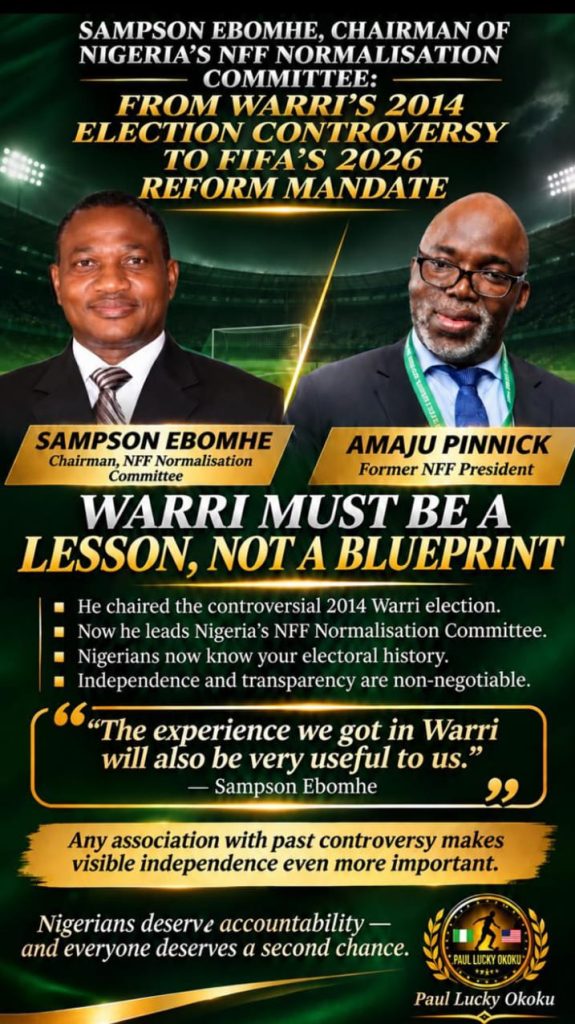
The appointment of Barrister Sampson Ebomhe as Chairman of the Nigeria Football Federation (NFF) Normalisation Committee has reopened discussions about the controversial 2014 NFF election in Warri, Delta State, which brought Amaju Pinnick to the presidency of Nigerian football.
In an extensive commentary, former Nigeria international and football analyst, Paul Lucky Okoku, acknowledged Ebomhe’s experience in football administration and legal practice but argued that his electoral history makes transparency and accountability particularly important in his new assignment.
FIFA communicated Ebomhe’s appointment on November 18, 2026, following consultations with the Confederation of African Football (CAF), while the NFF publicly confirmed the development on November 19. His final confirmation remains subject to eligibility checks by FIFA’s Review Committee.
Okoku, while wishing Ebomhe and other members of the committee success, said the new leadership must demonstrate that the lessons of the past can translate into meaningful reforms.
The football analyst recalled that Ebomhe chaired the September 30, 2014 NFF election in Warri, which produced Pinnick as federation president.
He noted that the election was surrounded by controversies, including Ebomhe’s detention and questioning by security officials before returning to oversee the voting process.
Another major controversy was the exclusion of presidential candidate Shehu Dikko, with Ebomhe reportedly attributing the decision to Dikko’s absence.
Pinnick subsequently won the second ballot with 32 of the 44 votes cast.
The election also faced legal challenges. On October 23, 2014, the Federal High Court in Jos set aside the Warri proceedings over alleged non-compliance with earlier court orders. Further disagreements emerged within the Electoral Appeals Committee over the validity of some election outcomes.
Okoku, however, stressed that the controversies surrounding the process did not establish personal wrongdoing by Ebomhe.
He also recalled Ebomhe’s December 9, 2014 remarks, reported by the News Agency of Nigeria, in which the lawyer described the Warri experience as an eye-opener.
Ebomhe was quoted as saying: “The experience we got in Warri will also be very useful to us.”
According to Okoku, the critical question now is whether those experiences will inform the reforms expected under his leadership.
A major concern raised by Okoku is the distribution of voting power within the NFF Congress.
He explained that under the electoral arrangement used in 2014, the 36 State Football Associations and the Federal Capital Territory collectively controlled 37 of the 44 votes, representing approximately 84.09 per cent.
Following statutory amendments adopted on March 23, 2026, the NFF Congress expanded to 108 delegates exercising 54 votes. However, the State Football Associations and FCT retained 37 votes, representing approximately 68.52 per cent.
Okoku argued that expanding the Congress without substantially redistributing voting power would not sufficiently address concerns about representation and electoral balance.
He acknowledged that Ebomhe did not necessarily draft the earlier statutes or approve the 2026 amendments, noting that statutory adoption is the responsibility of the appropriate NFF Congress.
Nevertheless, he maintained that the new committee must critically examine the existing arrangement and recommend a more inclusive electoral framework.
To strengthen his argument, Okoku examined football governance structures in Ghana, Côte d’Ivoire and Bosnia and Herzegovina.
He cited Ghana’s 2025 Football Association statutes, which provide for a 124-member voting Congress comprising representatives of professional clubs, regional associations and other football stakeholders.
According to him, Ghana’s arrangement gives its ten Regional Football Associations 20 votes, representing approximately 16.13 per cent of the total.
He also highlighted Côte d’Ivoire’s football governance structure, which reportedly provides voting representation for clubs across different divisions alongside recognised stakeholder groups, including players, coaches, referees and football medical professionals.
On Bosnia and Herzegovina, Okoku recalled how FIFA and UEFA suspended the country’s football federation in April 2011 over its failure to adopt compliant statutes. The suspension was lifted after the adoption of revised statutes in May 2011.
He argued that Nigeria should study these international experiences without necessarily copying any country’s model wholesale.
The former Flying Eagles vice-captain also advocated a stronger and permanent role for professional footballers in Nigerian football administration.
He referenced the June 10, 2026 cooperation framework between FIFA and FIFPRO, which recognises the global players’ union and establishes a platform for dialogue involving players, clubs and leagues.
He further cited UEFA’s February 12, 2026 ratification of FIFPRO Europe president David Terrier as its first player representative with voting rights on the UEFA Executive Committee.
Okoku maintained that Nigeria should adopt a similar approach by providing independently selected player representatives with meaningful voting influence in the NFF governance structure.
He welcomed the appointment of former Nigerian international Daniel Amokachi but insisted that players’ representation should become a permanent institutional arrangement rather than a temporary feature of the normalisation process.
Okoku also raised questions about the circumstances surrounding Ebomhe’s selection, particularly given his role in the 2014 election that brought Pinnick to power.
While acknowledging that Ebomhe’s legal practice and experience in football regulation, club licensing and electoral administration may have influenced his selection, he noted that FIFA and CAF had not publicly disclosed their individual reasons for choosing him as chairman.
He argued that Nigerians were entitled to seek clarification about the nature of Ebomhe’s previous relationship with Pinnick and whether any past football alliances could influence his present responsibilities.
However, he cautioned against treating past controversies as proof of wrongdoing.
“His independence must not simply be assumed because FIFA and CAF have selected him. It must be demonstrated through transparent decisions, disclosure of relevant relationships and fair treatment of all football stakeholders,” Okoku stated.
He added that the committee could not credibly promise a new beginning if personal loyalties, established relationships or existing power blocs were allowed to influence its decisions.
According to Okoku, the Normalisation Committee’s responsibility goes beyond organising another NFF election. Its most important task should be establishing a governance structure capable of delivering long-term stability and development for Nigerian football.
He identified five major areas requiring attention:
- Rebalancing voting power: Reviewing the dominance of the State Football Associations and FCT bloc, which currently controls 37 of the 54 votes.
- Permanent stakeholder representation: Creating meaningful representation for professional players, clubs, women’s football, coaches, referees and grassroots football institutions.
- Independent electoral administration: Establishing transparent procedures covering voter registers, candidate qualifications, screening, appeals and conflict-of-interest regulations.
- Open stakeholder consultations: Ensuring that relevant football constituencies participate in discussions on proposed statutory and electoral reforms.
- A clear reform timetable: Publishing a transparent schedule for statutory approval, nominations, elections and the eventual handover of responsibilities.
He emphasised that the proposals must be pursued through lawful procedures and consultations with FIFA, CAF and relevant stakeholders rather than imposed unilaterally by the committee.
Despite his concerns, Okoku maintained that Ebomhe should not be permanently defined by the controversies of 2014.
He argued that the appointment presents an opportunity for the lawyer to demonstrate what he learnt from the Warri experience and use that knowledge to build a more credible football administration.
“A second chance is not a reward for the past. It is an opportunity to demonstrate what one has learned,” he declared.
He further maintained that Nigerians deserve accountability while Ebomhe deserves an opportunity to prove that the lessons of Warri can lead to meaningful reforms.
In his conclusion, Okoku urged the Normalisation Committee to prioritise electoral restructuring, institutional independence and inclusive representation before the proposed May 31, 2027 deadline.
He said the ultimate objective should not merely be the election of another NFF president but the establishment of a system in which future football administrators emerge through a fairer process and remain accountable to the stakeholders they represent.
“Do not simply preside over another election. Help create the conditions for a fairer one,” he appealed.
He concluded that Warri should remain a lesson in Nigerian football history rather than become a blueprint for the country’s football administration.
Paul Lucky Okoku is a former Nigeria Flying Eagles vice-captain, former Super Eagles international, AFCON silver medallist, football historian, analyst and investigative football writer. He is also the Founder and Chief Executive Officer of Greater Tomorrow Children’s Fund (GTCF).