

Former Flying Eagles Vice-Captain Identifies Poor Technical Preparation, Players’ Welfare, Refereeing and Lack of Transparency as Major Challenges
Former Nigeria Flying Eagles Vice-Captain and former Super Eagles international, Paul Lucky Okoku, has called for comprehensive reforms in Nigerian football following Rangers International’s disappointing exit from the CAF Champions League.
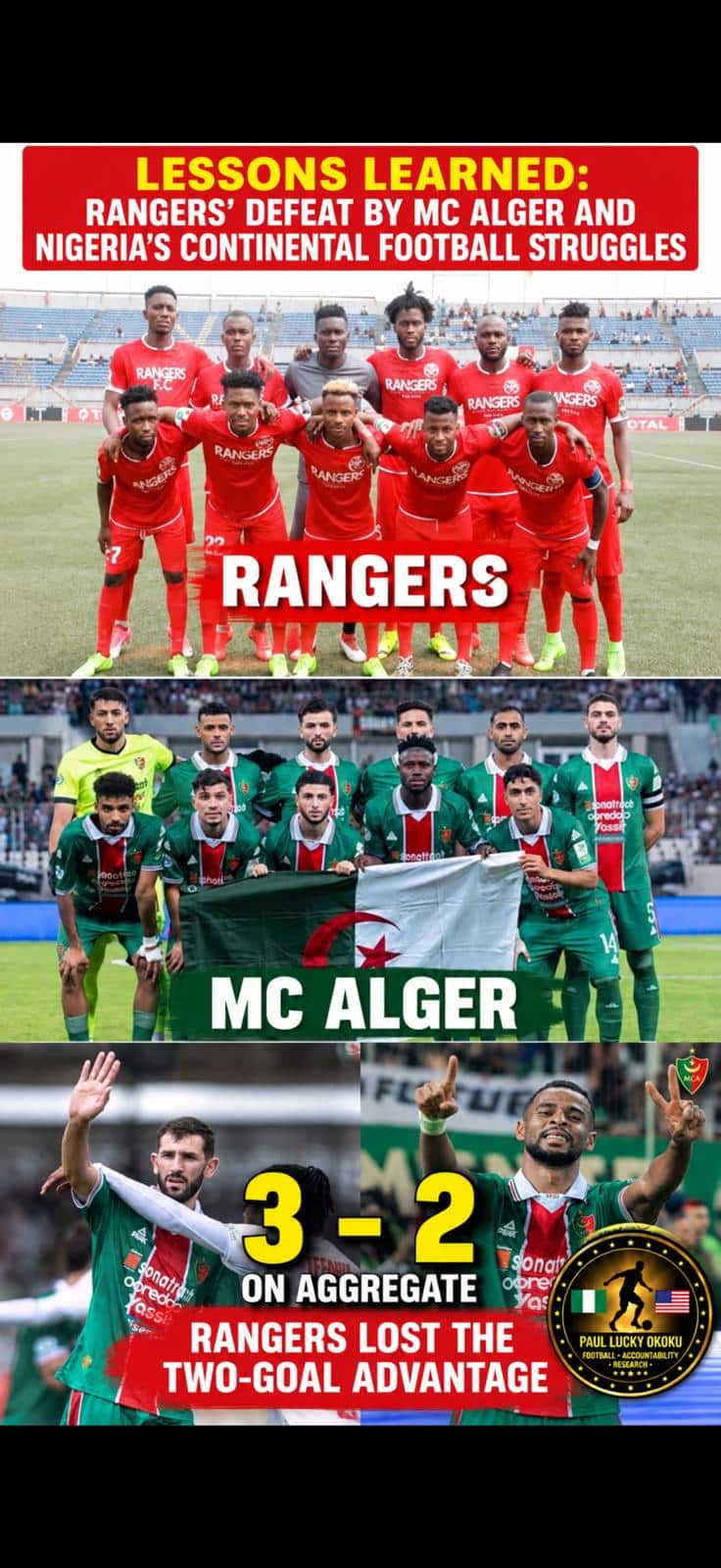
Okoku, a former AFCON silver medallist and football analyst, made the call in an extensive assessment of Rangers’ 3–2 aggregate defeat to Algerian champions MC Alger, warning that the setback should serve as an opportunity for Nigerian football administrators to address the structural challenges undermining the country’s continental competitiveness.
Rangers had secured a 2–0 victory over MC Alger in the first leg played in Abeokuta on October 18, despite playing much of the encounter with ten men. However, the Nigerian champions suffered a devastating 3–0 defeat in the return leg in Algiers five days later, surrendering their aggregate advantage.
The Algerian side scored in the 58th and 84th minutes before completing their comeback with a stoppage-time goal.
According to Okoku, the statistics from the encounter exposed the extent of Rangers’ difficulties, with MC Alger enjoying 69 per cent possession against Rangers’ 31 per cent. The Algerians also recorded 30 shots compared with Rangers’ two, while shots on target stood at nine against one. MC Alger equally dominated corner kicks by nine to one.
Although Rangers goalkeeper Abuchi Okeke saved a penalty during the encounter, the Nigerian side could not withstand the sustained pressure.
Okoku questioned the team’s tactical adjustments, defensive organisation, management of set pieces and inability to relieve pressure, insisting that the technical crew must provide answers through a comprehensive post-match assessment rather than allowing the defeat to generate only public criticism.
CONTINENTAL DISAPPOINTMENTS BEYOND RANGERS
The football analyst observed that Rangers’ elimination was not an isolated disappointment for Nigerian clubs.
On the same October 23, El-Kanemi Warriors also exited the CAF Confederation Cup against Morocco’s Raja Casablanca after conceding twice late in the encounter, losing 4–2 on aggregate.
He further recalled Remo Stars’ 7–1 aggregate defeat to South Africa’s Mamelodi Sundowns in 2025, including a 5–1 home defeat.
Okoku maintained that although the circumstances surrounding the different matches were not identical, the recurring continental setbacks should compel the Nigeria Football Federation (NFF), Nigeria Premier Football League (NPFL) and club administrators to examine the quality of domestic football and the level of preparation of Nigerian representatives.
DOMESTIC LEAGUE STANDARDS AND PLAYERS’ WELFARE
Okoku argued that the quality of a country’s continental representatives is largely influenced by the competitiveness of its domestic league.
He questioned whether the NPFL consistently exposes players to the speed, tactical discipline, physical intensity and quality of competition required to compete successfully against leading African clubs.
He also identified players’ welfare as a major concern, citing the NPFL’s October 2024 withdrawal of new-player licences at nine clubs over unresolved salary and entitlement issues.
According to him, professional footballers cannot be expected to deliver their best when they are burdened with financial insecurity, unpaid wages and uncertainty about their contractual entitlements.
While acknowledging that financial difficulties cannot excuse every poor performance, he stressed that professional treatment of players is an essential component of professional football.
He called for stronger enforcement of contractual obligations, prompt resolution of disputes and strict adherence to club licensing requirements.
REFEREEING STANDARDS REQUIRE URGENT ATTENTION
The former international also raised concerns about refereeing standards, calling for improved training, objective performance assessment, transparency in appointments and appropriate disciplinary measures where misconduct is established.
He referenced the NFF’s October 2, 2026 directive acknowledging erroneous decisions and incorrect interpretations of the laws of the game, describing it as an opportunity to strengthen the country’s refereeing system.
Okoku said consistent application of football regulations would improve confidence in the domestic league and better prepare Nigerian players for continental competitions.
QUESTIONS OVER FIFA FORWARD DEVELOPMENT FUNDS
Another major issue raised by the football analyst concerns transparency and accountability in the utilisation of FIFA Forward development funds.
He explained that FIFA Forward 3.0 provides eligible football associations access to funding of up to US$8 million during the 2023–2026 programme period, subject to established conditions and approved activities.
He therefore challenged the relevant football authorities to make public details of Nigeria’s allocations and expenditure, including youth competitions organised, referees trained, facilities developed and other approved football development projects.
Okoku called for the publication of audited accounts, project-completion reports and measurable outcomes to enable stakeholders assess the impact of the funding.
He cautioned, however, against presenting allegations of financial mismanagement as established facts without supporting evidence, insisting that transparency should expose both achievements and failures.
FOOTBALL ADMINISTRATORS URGED TO EMBRACE ACCOUNTABILITY
Drawing an analogy with workplace safety, Okoku argued that when an employee suffers an injury, an investigation should go beyond blaming the victim to examining the systems, responsibilities and preventive measures that failed.
He said the same principle should apply to Nigerian football.
According to him, clubs must review their scouting systems, fitness programmes, substitutions and match management, while administrators should examine players’ welfare, facilities, logistics and institutional support.
The NFF and league organisers, he added, must also take responsibility for refereeing development, competition standards and football development programmes.
He emphasised that every identified weakness must have a responsible authority, a clear deadline and verifiable evidence of corrective action.
SUPPORTERS REMAIN AN IMPORTANT PART OF THE GAME
Okoku also highlighted the importance of supporters in the development of Nigerian football.
While acknowledging the growing attraction of foreign leagues such as the English Premier League and Spanish La Liga, he maintained that Nigerians could enjoy international football while remaining committed to supporting local clubs.
He noted that passionate home support could inspire players and create an exciting atmosphere, as witnessed during MC Alger’s home victory.
However, he argued that football administrators must first provide supporters with compelling reasons to return to stadiums through improved facilities, dependable fixtures, credible officiating and entertaining football.
CALL FOR A COMPREHENSIVE FOOTBALL REFORM AGENDA
In his concluding remarks, Okoku called on the relevant football authorities to move beyond routine post-match criticism and develop a practical reform agenda capable of improving Nigeria’s performance in continental competitions.
He proposed that recent continental representatives should be brought together to identify recurring weaknesses and develop measurable solutions.
Among the areas requiring urgent attention are tactical and match-management training, players’ welfare, salary compliance, referee development, improved domestic competition standards and transparent utilisation of football development funds.
He stressed that Rangers’ two-goal first-leg advantage had been lost, and no amount of criticism could reverse the outcome.
However, he maintained that the country still had an opportunity to address the structural problems responsible for repeated disappointments.
“A lesson is not learned until it prevents a repeat,” Okoku declared.
He urged football stakeholders, supporters and administrators to treat the Rangers defeat as a wake-up call and work collectively towards restoring Nigeria’s competitiveness in African football.
About the Writer
Paul Lucky Okoku is a FIFA Legend, former Nigeria Flying Eagles Vice-Captain, former Super Eagles international, AFCON silver medallist, football historian, analyst, investigative football writer and journalist-at-large. He is also the Founder and Chief Executive Officer of Greater Tomorrow Children’s Fund (GTCF).
The article is intended to stimulate constructive discussion, accountability and reforms for the future of Nigerian football.
Follow us on Facebook @ Ndokwa Vanguard